On Friday morning, news reports surfaced that China had acquired an Internet cannon. And … wait: What is this about China having an Internet cannon?
If you feel terrifyingly out of the loop, take a deep breath and read the following to learn more about what an Internet cannon is and what it can do.
What is an Internet cannon?
More commonly known in the hacker community as a Low Orbit Ion Cannon (LOIC or WebLOIC), an Internet cannon is a type of computer program used to force traffic overloads (or denial-of-service) onto targeted websites. It uses the Internet to blast out cyber attacks. It’s not a literal cannon.
So even though you read “Internet cannon” and were probably imagining something like this:
 (US Navy)
it actually looks more like this:
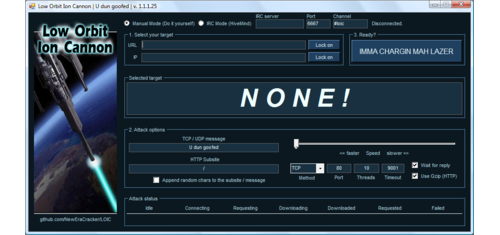
Why does China have one?
A new report and analysis claims that China is using what is being termed the “Great Cannon,” ostensibly a type of LOIC, to force an overflow of Web traffic and malicious code onto sites its government wishes to squash in the name of censorship. (If a website is overwhelmed by traffic, real or manufactured, no one will be able to visit it.) The new cybertool is being used in conjunction with its “Great Firewall,” which already blocks access to sites like Facebook and Twitter on Chinese networks.
Denial-of-service attacks on two GitHub project pages last month arenow being credited to China’s Great Cannon. The GitHub pages were hosting Chinese censorship circumvention projects run by the anonymous, presumably Chinese activist site GreatFire.org.
Jeesh. That sounds terrible. What kind of country would build such a heinous cyberweapon?
Well, the United States has a similar program.
According to the New York Times, information provided in the Edward Snowden leaks outlines U.S. government systems that can intercept and redirect Internet traffic to a site of their choosing.
Of course, we don’t know of any instances where the U.S. has used an Internet cannon-type attack in domestic censorship.


No comments:
Post a Comment